Summary
Creating realistic virtual environments has traditionally required a significant amount of time, specialist 3D expertise and production resource. Whilst AI is definitely helping to improve the time to air, Gaussian Splatting offers a very different approach: capture a real location, reconstruct it as a navigable 3D environment, and potentially bring that environment directly into a virtual production workflow.
We recently started experimenting with Gaussian Splats and showcased them at IBC 2026. What struck me wasn’t simply how impressive the technology looks.
It was also how simple the idea behind the workflow could become.
Instead of asking a 3D artist to recreate a stadium, studio, venue or real-world location from scratch, what if we could simply capture the real thing?
That immediately got me thinking about workflows in broadcast but then enterprise, education and more.
Because we’ve spent decades finding increasingly sophisticated ways of creating virtual worlds. Gaussian Splatting potentially gives us another option: start with the real world and turn that into the virtual one.
A Gaussian Splat flyby of the Vfl Bochum stadium and their dressing room.
From scans to a 3D world
Gaussian Splatting is a relatively new technique for reconstructing a three-dimensional scene from a collection of images. It’s been used for computer graphics and rendering since the early 2000s, but the modern breakthrough for real-time 3D scene reconstruction—known as 3D Gaussian Splatting—was introduced in 2023. There is a good explanation here: https://www.nianticspatial.com/en/blog/intro-gaussian-splats
And our friends the Corridor Crew cover it very well here: https://www.youtube.com/watch?v=X8yRlA7jqEQ&t=6s
You capture a location from lots of different viewpoints using a LIDAR camera (you can even use an iPhone) Software analyses those images and reconstructs the scene using millions of tiny 3D Gaussian elements — or “splats”.
Rather than ending up with a conventional photograph or a piece of 360-degree video, you have a representation of the environment that can be viewed from different positions. And each of those splats has multiple data points to help you visualize and control your environment.
You can move through it or fly through it.
A panoramic image lets me stand somewhere and look around. A Gaussian Splat begins to give me the feeling that the space itself has been captured.
And that’s obviously where we can build an advantage for virtual production.
At Vizrt days our colleagues at Düsseldorf University had scanned the entire conference room and were showing it inside a Viz Engine running Unreal. We were also showing our new Vizrt AI Keyer™ next door. Wouldn’t it be fun I thought to send the Vizrt AI Keyer™ output and Reality Connect skeletal data to their engine. The result was indeed fun. I could walk around their 3D scanned environment and kick over some virtual chairs:
Gaussian Splatting - An experiment at Vizrt Days 2026
At Vizrt Days 2026, our colleagues at Düsseldorf University scanned the entire conference room and showed it inside a Viz Engine running Unreal.
Bringing a football stadium into Viz Engine 5
For IBC, we wanted to bring the concept to a sports application our colleagues Jakob and Jens at Düsseldorf University captured a real football stadium environment.
Jakob walked around the location recording it from multiple angles, making sure there was enough visual information for the reconstruction process. We spent more time in the locker room knowing this might be a good example of somewhere to tell our story from and took a few additional HD still images here. These are used later in the software to improve the final result.
The result was a surprisingly convincing digital version of the real space, i.e. a digital twin.
Details like seats, structures, corridors, dressing-room details and the character of the venue can be retained because they haven’t been recreated by an artist. They have been captured from reality. And that changes the economics of creating certain types of virtual environment.
Traditionally, if I wanted that environment for a virtual production, somebody would potentially have to model the geometry, create textures, reproduce signage, build materials and light the environment.
And that is absolutely the right approach for many productions.
But sometimes you don’t need to design a world. You just need to capture one.
The real world becomes the set
Once that environment exists in 3D, we can start thinking about it as a production asset. A presenter could appear inside the dressing room. Move to the pitch. Stand beside a recognizable feature of the venue.
Graphics can then be introduced into that environment to tell the story.
In the example shown at IBC, we’re no longer simply looking at a reconstruction of a football stadium. We can begin combining the captured environment with the things Vizrt has been doing for years: real-time graphics, virtual sets, augmented reality and data-driven storytelling.
Put those things together and the Gaussian Splat stops being a technology demonstration. It starts becoming a broadcast environment.
Now you can extend this into other areas and markets, such as the enterprise space. A CEO could scan the boardroom, allowing them to be virtually present from any location when combined with the Vizrt AI Keyer™
Capture once, tell lots of stories
Imagine sending someone to a sporting venue before an event with a relatively lightweight camera setup. They capture the dressing room, tunnel, pitch, hospitality areas or perhaps the entire venue. Those captures become reusable 3D assets.
Back at the production center, a presenter could potentially explore those locations without physically being there.
For sport, you can immediately imagine the possibilities.
A presenter could stand inside a reconstructed stadium while discussing team statistics. Graphics could appear alongside them. An analyst could move around an area of the venue while explaining tactics. A sponsor could be incorporated naturally into a virtual presentation.
We also explored integrating AR elements within the same Gaussian Splat environment.
But it doesn’t stop at sport.
News organizations could capture locations relevant to major stories. Entertainment productions could digitize interesting venues. Corporate teams could capture factories or facilities. Event producers could bring remote locations into a studio presentation.
Suddenly the question becomes:
What places could we turn into content?
Since exploring this technology, I’ve found myself thinking this way. Jakob and I were walking around IBC saying, “We could scan that… we should scan this.” And so, we did.
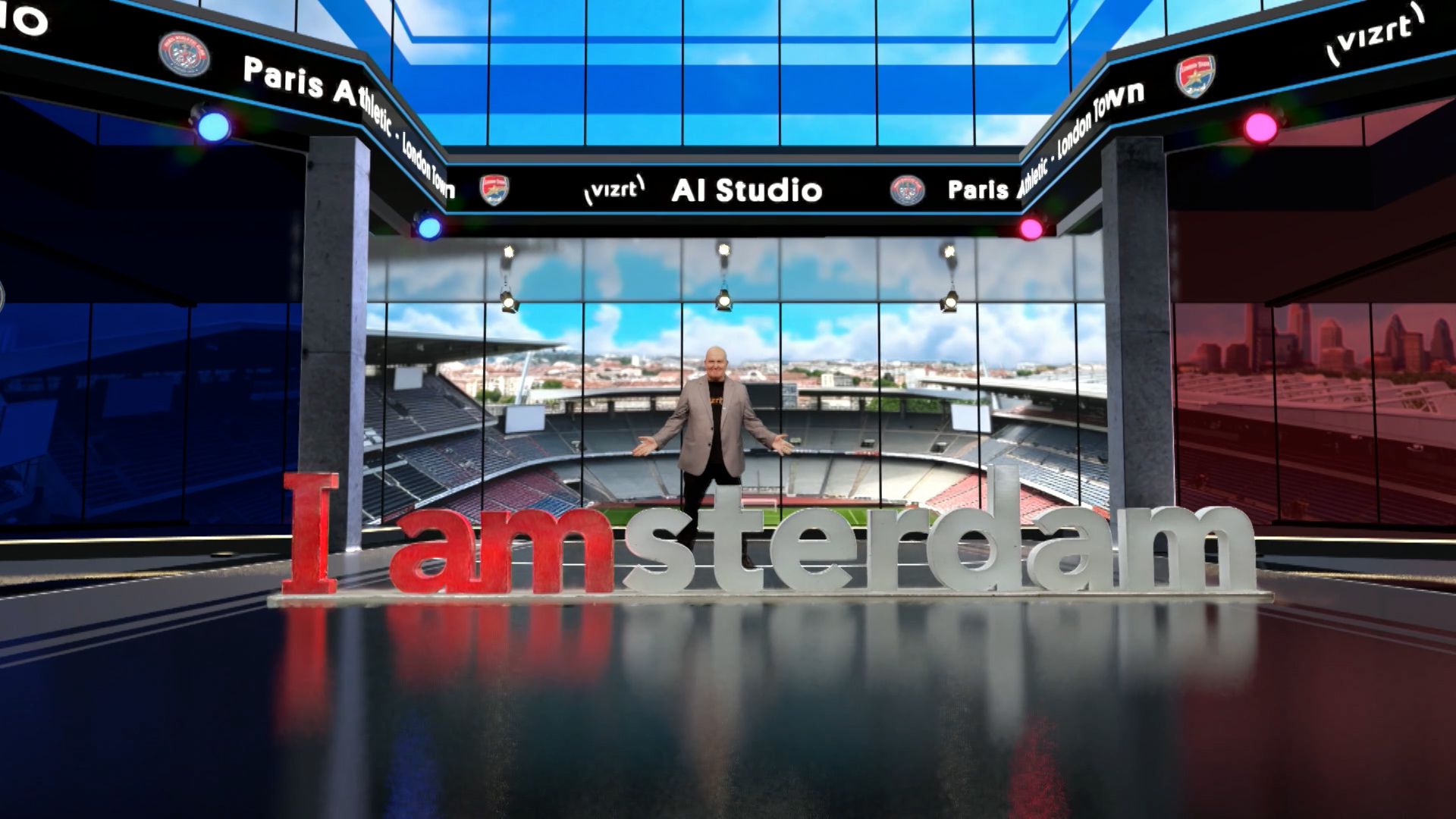
Gaussian Splatting in Amsterdam
Scanning the outside of the RAI then just using the IAmsterdam sign. So, you don’t have to use the entire environment you might want to just bring in something as an AR object. So, Jacob and Gael discarded what we didn’t need and just brought the sign in to the engine as you can see in this video.
Not everything needs to be perfectly modelled
There are obviously limitations.
Gaussian Splats aren’t a replacement for traditional 3D modelling, and there are situations where clean geometry, precise materials and complete artistic control are essential.
Captured environments can also contain imperfections. Moving people, reflective objects and areas that haven’t been photographed sufficiently can all create reconstruction problems that might take time to edit out.
But I’m not sure perfection is always the point.
In storytelling, authenticity can be incredibly powerful.
There is something compelling about knowing that the dressing room behind the presenter isn’t an artist’s interpretation of the dressing room.
The same applies to the stadium, exhibition hall, city street or concert venue.
And as capture technology and reconstruction algorithms continue improving, the gap between captured reality and traditional 3D environments is going to become increasingly interesting.
The workflow is becoming the innovation
This reminds me a little of what we’re seeing with Vizrt AI Keyer™. The important change isn’t necessarily one individual piece of technology. It’s what happens when several technologies start removing steps from the production process.
With Vizrt AI Keyer™, we can rethink the assumption that virtual production always requires a green screen. As I explored in my earlier article, identifying the subject rather than a particular chroma color makes productions far less dependent on perfectly controlled environments. Gaussian Splatting raises a similar question at the other end of the workflow.
What if building the virtual environment didn’t always require building it?
- Capture the location.
- Process it.
- Bring it into the production.
- Add the presenter.
- Add real-time graphics and data.
Tell the story.
That is a fundamentally different way of thinking about content creation. Imagine covering an international sporting event and capturing distinctive locations around the host city. Those locations could become part of the presentation package without requiring crews and presenters to remain permanently on location.
Or capturing a sponsor’s product and bringing it naturally into a virtual studio.
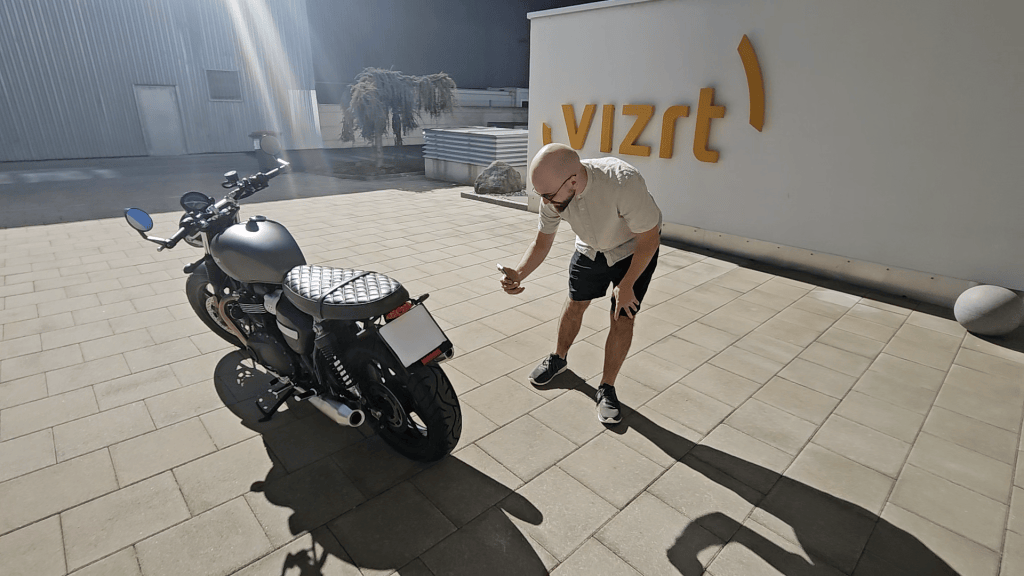
A motorcycle, for example, doesn’t necessarily need to be painstakingly recreated as a traditional CG model before it can become part of the storytelling environment. The physical and virtual worlds start becoming much easier to mix.
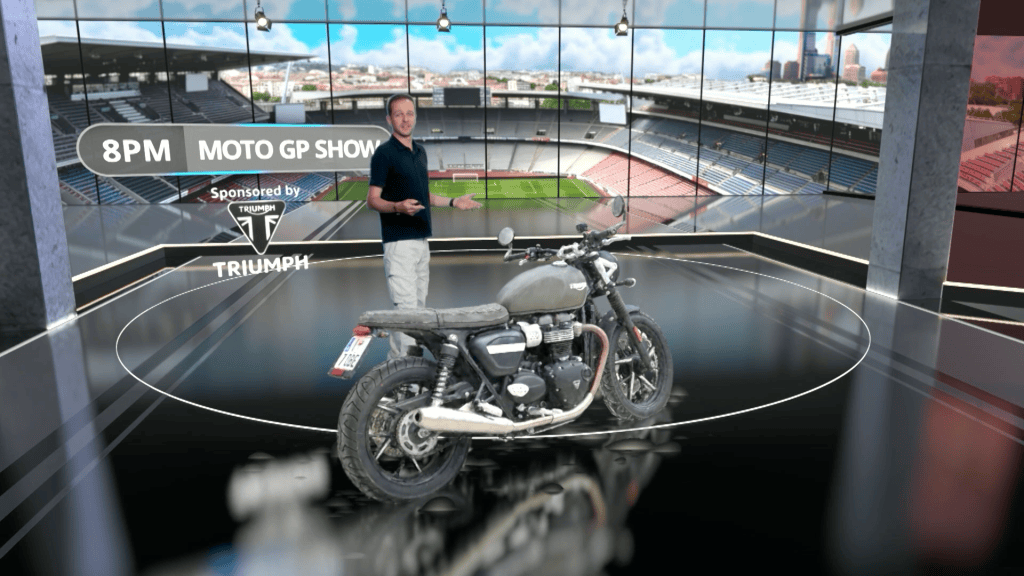
We successfully imported the scanned motorbike into our IBC Demo.
Virtual production is becoming less virtual
That’s perhaps the slightly ironic conclusion I’ve reached from experimenting with this.
For years, virtual production has been about creating convincing alternatives to reality.
Technologies such as Gaussian Splatting increasingly allow us to start with reality itself.
Combine that with AI-based keying, real-time rendering, camera tracking, NDI, cloud production and Vizrt’s real-time graphics capabilities, and we have the beginnings of a very different production model.
We’re moving towards workflows where a relatively small team can capture a location, digitize it and turn it into a storytelling environment far more quickly than would previously have been practical.
There is still plenty to explore. In fact, in the world of AI, there are now services that can generate a Gaussian splat from a prompt. A good one to try out is – Marble.They also have an app available for iPhone and Android.
But I think Gaussian Splats are worth paying attention to — not simply because they look impressive, but because of the workflows they could unlock.
And, as we’ve seen repeatedly in broadcast technology, the really interesting innovations aren’t always the ones that make the pictures better.
Sometimes they’re the ones that make something possible that previously required an entirely different production.
Technical notes
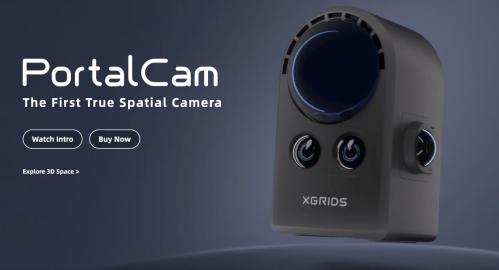
- You need a good Camera and often that’s where the differences between the quality of the environment. We used the Xgrid’s – https://www.xgrids.com/intl/portalcam (They also do really cute plushy’s of the portal camera that I had to bring one home for my son!)
- But they also do an app for the iPhone that works surprisingly well – here’s a scan of one of my guitars – link
- Then of course you will need the latest version of Viz engine and a decent GPU to render all those splatts.
- It takes anything from five minutes to an hour to do a scan depending on what you want and you can augment it with HD images to get the kind of quality you see on our locker room
- More info on the amazing work of Dusseldorf University here: https://vsvr.medien.hs-duesseldorf.de/presentations/vizrtdays2026/ and https://de.linkedin.com/school/hsduesseldorf/
- Jakobs explanation of GS at Vizrt Days: https://www.linkedin.com/feed/update/urn:li:activity:7471580692049534976/
- Of course, you should always get permission before using the scans in public!