High schools across the US are discovering something powerful: professional grade sports production isn’t just for major networks anymore. With the right vision, leadership, and technology, even a modest school budget can support a full broadcast operation, one that elevates school spirit, builds real world skills, and connects entire communities.
The Challenge: Big Vision, School Budget
When I first set out to build a professional quality sports production program at Alamo Heights High School, the idea felt bigger than the resources we had.
Like most US high schools, we didn’t have a dedicated production budget, a production studio, or a room full of high-tech broadcast equipment. But, we were getting a new jumbotron, which came with a few basic pieces of hardware. And that’s how it usually starts at most US schools, you get a new videoboard – because that’s the centerpiece at every stadium – and you build everything else around it. So, we had our work cut out for us as everything else – from cameras to switchers to crew – had to be found.
What we didn’t have in money, we had in support. I had no trouble recruiting a few other teachers to the cause. And, our principal believed in the vision early and backed the idea that this could become a real educational opportunity for the students.

John Muñoz
Vizrt Live Production Specialist
So, buoyed by that, I set an ambitious goal for our first year. Create a student-run sports media department capable of:
- Livestreaming games, complete with replays
- Producing instant highlight reels
- Building coach and athlete features
- Creating shows and digital content
- Selling sponsorships to generate revenue
(I’d recommend starting with this in any pitch to the higher-ups)
All the equipment was purchased via a school bond, and all the revenue we were bringing in was then handled through a foundation, which then disbursed funds to different school departments. My share of the pie was around USD10,000 a year, which were ample funds to run the program.
The Setup: Professional Tools, Student-Friendly Workflow
To bring the vision to life, I built a production workflow around integrated Vizrt technology, because our team needed tools that:
- Worked together without constant troubleshooting
- Were intuitive enough for students with zero experience to handle
- Could scale as our ambitions grew
Here’s what ended up as our kit: Stadium Control Room Setup
- TriCaster TC1 switcher
- Flex Control Panel
- Viz 3Play 3P1 replay system
Our Away‑Game Setup
- TriCaster Mini
- Viz Connect Solo converters
With NDI as the backbone, because this allowed me to break up my sports media team during home games into three groups, all accessing the same video and audio.
Students could:
- Monitor live feeds
- Control systems remotely via KVM (keyboard, video, mouse device that can control multiple computers via a single console)
- Feed graphics, laptop screens, Adobe Premiere, and more directly into the TriCaster
For a team that has very little experience and resets every year as students graduated, I cannot stress the importance of an integrated, simple workflow. One that flat out works. Even installation surprised the team with its simplicity. Setting up NDI Discovery Server, for example, was straightforward thanks to Vizrt’s training videos and Viz University courses.
Outcome: Students Confidently Running Professional Broadcasts
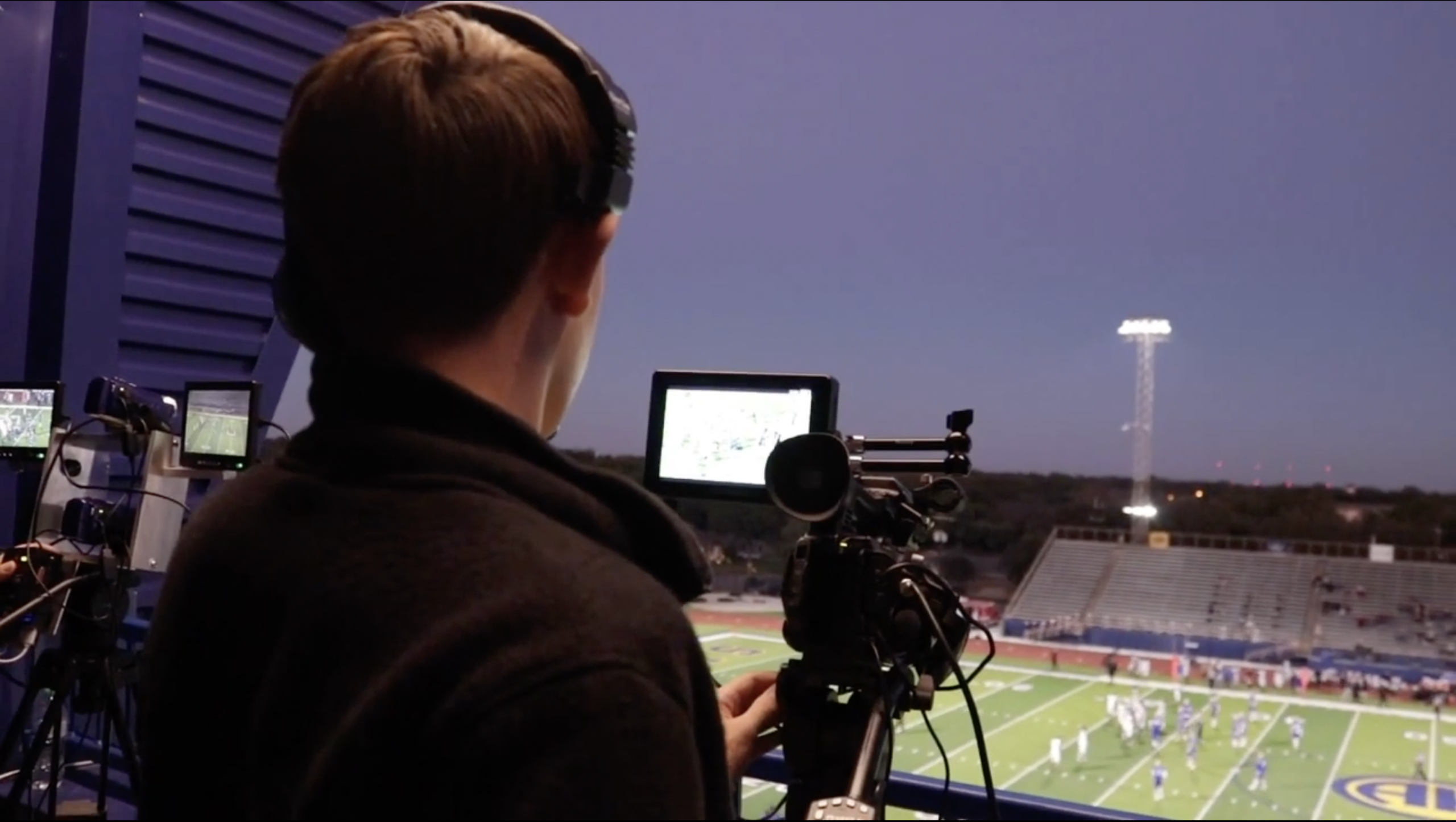
One of the most rewarding elements was how quickly the students took ownership. Many came in with no experience, but willingness to learn in spades. And, after some hands-on training, they were able to run entire broadcasts themselves, with myself and the other teachers supporting in a supervisory role. We ran the whole gamut of productions from multicamera football games to basketball, soccer, graduation ceremonies, morning announcements, talent shows and even a live launch of a rocket built by our students.
We even partnered with local channel KSAT News for their “Big Game Coverage”. I may be biased, but they ran a tight, flawless show, and there were many times the control room erupted in cheers at the end of the game. The students were not just learning production skills, they were also learning about life skills – teamwork, discipline, timing, and having each other’s backs when things did not go to plan.
ROI: Revenue, Reach, and Real‑World Opportunities
The program paid off in more ways than one. We began generating revenue from advertising and sponsorships. As I mentioned earlier, my team received around USD10,000 each year, which was a great return on our investment. Our YouTube channel grew steadily, and one game hit nearly 30,000 views. Coaches even asked us to temporarily hide certain videos during playoff season so opposing teams, who were known to watch our feed, couldn’t steal our secrets.
The program also opened doors for students. The crew picked up paid gigs from community members and used their production experiences for college admissions or internships. This is what happens when young creators get real gear and real responsibility – they learn and grow. And for me as an educator, that is the real goal of programs like this.
What I would’ve added with a Bigger Budget
I get asked this a lot. Well, if our budget grew by even 30%, the next step would be to expand into professional graphics and analysis with tools such as Viz Flowics for cloud-native graphics, so you could create and control graphics from anywhere, especially useful for away games, and Viz Libero for advanced sports analysis and telestration. These tools would have taken our storytelling to another level, similar to what students see on TV, and at the same time helped coaches refine training, and create athlete performance video portfolios that the athletes could share with scouts and colleges.
For schools starting from scratch, watch the webinar recording (link below), in which we cover a lot of ground on how to get started. And if you are a school producing for ESPN feeds, Vizrt has recently introduced packages with ESPN-compliant graphics. It’s been packaged for simplicity, affordability, and fast adoption by student crews.
Want More Help Getting Started?
If your high school is exploring a similar program – or if you don’t know where to begin – watch this webinar I was part of recently, along with in Harold White, and educator and live production champion from New Mexico. We covered a lot of ground, including gear, infrastructure, budgets, as well as building and motivating student-run workflows, most importantly, what to avoid!