Summary
With the Winter Olympics in February 2026, Nine Network in Australia didn’t just deliver a premium broadcast. It redefined its live sports production model, combining AR visuals, remote workflows, and future‑ready infrastructure. What began as an Olympic project has become the foundation for how Nine will tell sports and other stories for years to come.
The Challenge
Nine Network is an Australian commercial free-to-air television network. It holds rights to a diverse sports portfolio, from the Australian Open to the Olympics, Champions League, Rugby League and more, and is known for delivering a premium, world‑class sports experience for fans.
For the Winter Olympics, Nine faced a unique challenge:
- Deliver a broadcast that matched the prestige of the Games
- Operate across multiple time zones, with live presentation from Italy and production teams based in Australia
- Design a studio solution that could effortlessly scale beyond sports to news and entertainment
As Alex Rolls, Head of Creative and Innovation at Nine Network, explained, this was not just about branding one event. Instead, this was about reimagining Nine’s studio and graphics infrastructure for the future. While at the same time, maintaining that hallmark Nine graphics look and feel, with all of the graphics specifically created for each event, designed in-house.
What Nine landed on: Hybrid Physical & Augmented Reality Studio Built for Scale
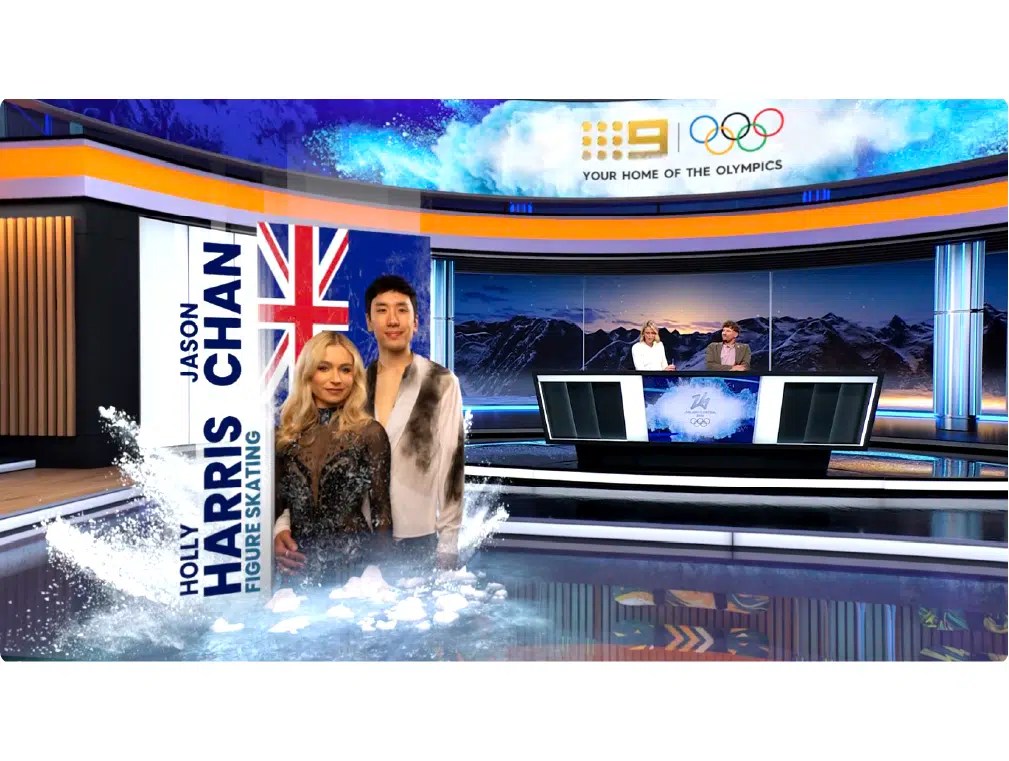
Rather than relying on a traditional green‑screen setup, Nine worked with Jago Design, AE Live and Vizrt to build a hybrid 3D studio combining physical elements with augmented and extended reality layers.
A single level work area was transformed with technology into a multi-story environment, complete with an ice rink and Olympic museum, giving producers a wide range of visual storytelling options. Nine had already had phenomenal success with a hybrid-remote production during the Summer Games in Paris, and right after that event ended began planning for the 2026 Winter Games in its new studio space.
The studio is powered by Viz Engine integrated with Unreal Engine. This integration gives designers the benefit of composing directly in Viz Engine, and leveraging a unified, real-time workflow for high-end virtual sets and AR to deliver different virtual environments. With the ability to seamlessly blend presenters, graphics, and immersive environments on air. A large LED wall surrounds the set, displaying panoramic views of the Italian Alps, and live graphics are integrated directly into the virtual environment, so everything appears naturally within the set.
“The whole process was flawless, with the support from Vizrt and AE Live. We are a very Vizrt-based business, so it was a no-brainer to use Vizrt. It’s pretty impressive. We have total flexibility. We can easily change the studio to suit any production, fast. We can build whatever we need in this space, including sponsorship spots,” says Alex.
But, at the same time the studio also had to be stable for different types of live broadcasts, which is why Nine opted for the Vizrt virtual studio solution, as it gave it the potential to use the space in the future with existing infrastructure like Viz Mosart (Vizrt’s studio automation system) and Viz Pilot Edge (templated graphics solution).
The team incorporated these key features:
- A modular design that could be rapidly re‑skinned for different sports during Games coverage
- Tracked cameras driving AR elements
- Real‑time data integration for medal tallies, athlete profiles, and timing
- Seamless visual continuity between the small team at the on‑site studio in Italy and the main studio in Australia that saw at-home presenters placed in the Italian Alps.
- All graphics and editorial handled from the base in Sydney.
“The visual elements were so convincing that viewers believed that our presenters in Sydney were also on location in Livigno,” adds Alex.
Immersion Without Interruption
Once they had the pieces in place to make the studio as impressive as it could be, with the majestic Alps as the background, Alex and his team embarked on the next goal – to support storytelling with AR and graphics that would complement this stunning new studio build – by turning the studio into a living environment. For technology to “wash over the viewer”, enhance the narrative and serve as an extra prop for presenters, so they did not have to stop and explain what was happening. Instead, they could let the graphics do the talking as well.
These included:
- AR athlete profiles to help audiences connect with competitors who were unfamiliar or hidden behind helmets
- Countdown clocks and event reminders to encourage viewers to stay up and watch the medal ceremonies (Sydney is 10hours ahead of Milan)
- Time‑of‑day lighting, weather data that matched conditions in Italy, reinforcing authenticity in the studio
Stronger Engagement, Positive Feedback
It wasn’t just the presenters and production teams who embraced the new studio environment that looked like the Italian Alps. Audiences, too loved the new look with viewership hitting 30% higher than expected, despite the time difference which meant quite a few events were taking place after midnight in Australia. More than 14 million viewers tuned in during the Games, exposing Nine’s sponsors to audiences at scale.
Nine has relied on Vizrt technology for over 20 years, and knows from past experiences that Vizrt provides reliability at scale. For live sport, speed and systems that production teams can depend on matter just as much as creativity.
As Alex added, “Innovation must never compromise accuracy. We need data-driven graphics that are fast, dependable, and the real role of technology is to help us create bigger and better. A virtual studio is a giant graphic canvas, and needs to evolve with every new angle we take in storytelling.
“They say that free to air TV is in decline, but our sports broadcasts are repeatedly increasing viewership and bucking this trend. Our Australian Open viewership was 20% higher this year. With the Winter Olympics, we came at it with the same energy, and our numbers were up 30%. It’s a cliché, but it really is down to great storytelling – the combination of great stories, great graphics, and passionate coverage.”
Alex Rolls
Head of Creative and Innovation at Nine Network
From Olympics to Everyday Sports – and Beyond
As a free‑to‑air broadcaster, Nine sees the virtual studio as a long‑term platform for expanding sponsor storytelling, to move beyond static logos to immersive, contextual brand environments.
The network is now leveraging the momentum of its Winter Olympics coverage to solidify its 2026 sports portfolio, which now features a significant expansion into rugby. First up was the Rugby League in Las Vegas at the end of February 2026, and later in the year Rugby Union. Initiatives include developing new AR templates for team line-ups, player statistics, and analysis, as well as exploring increased automation in sports production.