
Summary
How an integrated Vizrt ecosystem helped Naftemporiki TV build a modern financial newsroom in six months, give journalists greater control over their stories, and enable solo news co-pilots to deliver 15 hours of live television a day.
Founded in 1924, the Greek financial media house Naftemporiki spans print, digital, social media and Naftemporiki TV.
When the owner of Naftemporiki set out to build a television channel, the brief was not to simply add another platform to the respected news brand – but to design a different kind of newsroom.
“We built this channel in six months… with a goal of producing 15 hours of professional live TV every day,” says CTO Iakovos ‘Jacob’ Panourgias.
“We are the first financial news channel in Greece. From day one, our management wanted the most modern and compact channel to deliver news at the same standard of a global financial channel like CNBC.”
As the first step, Panourgias looked at how a modern newsroom could operate if the production workflow were designed as one connected system from input to output. The transformation brought together Naftemporiki’s engineering team, Vizrt and systems integrator Comart S.A.
For Simos Hajiraptis, Comart’s Managing Director, the goal was not simply to install more technology, but to create an integrated production process.
“The Naftemporiki project was both a challenge and a great opportunity for us. The idea was to completely transform the way a relatively small broadcaster operates by introducing a wide variety of Vizrt technologies and creating a modern, integrated workflow,” says Hajiraptis.
“This project demonstrates how with the right tools, channels like Naftemporiki TV, can use advanced technologies to operate efficiently and smoothly, and while achieving the production quality of a larger organization.”
One newsroom, one connected workflow
“The choice of Vizrt was based on two factors: graphics quality and the ability for multiple production tools to work together as one ecosystem,” adds Panourgias.
Behind that workflow is a portfolio of Vizrt tools – Viz One as the production asset management system, Viz Story for editing videos and publishing stories to multiple platforms including social media, Viz Pilot Edge for newsroom graphics creation, Viz Multiplay to control the videowalls, Viz Trio for playout, TriCaster switcher and Viz Engine for compositing and rendering graphics.
Financial news moves quickly. Stocks change and stories can develop while a bulletin is already on air. That makes flexibility as important as efficiency and ease of use, with everyone from editorial to the technical team pulling in the same direction. That required a change in mindset from how news is traditionally produced in Greece.
“With the Vizrt ecosystem, we work like a big channel, but with a small team. Our biggest success, I think, is everyone working together in one big, connected system,” says Panourgias.
Journalists at Naftemporiki build rundowns, work with video, add graphics, reuse existing stories and make last-minute changes.
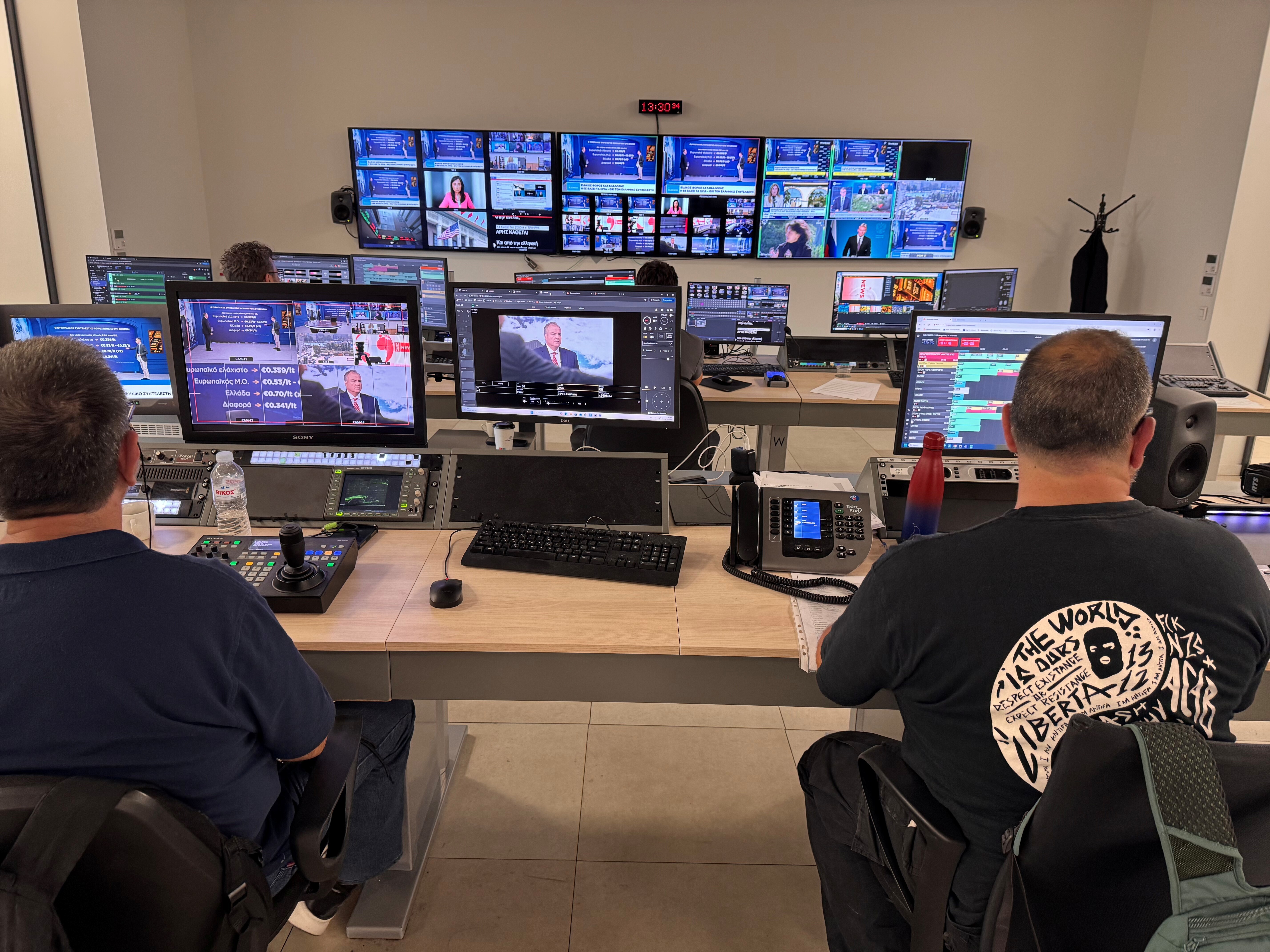
A “co-pilot” team sits as a bridge between editorial and technical operations.
Meet the Naftemporiki co-pilot
In a traditional control room, you would find different operators doing different tasks like controlling graphics operator or automation. At Naftemporiki, the co-pilot understands the technical aspects, but also thinks about the complete show, and how a program needs to come together editorially.
Stories begin in Showmaker (the web-based rundown creation tool for Viz Mosart).
“Our journalists build the show in Showmaker. Every story is already there with the video and the graphics ready to go. Then when we go live, Viz Mosart takes over (executing the prepared actions).
“I just press one button and everything happens together – camera, video, graphics, sound,” says Antonis Papatheodoropoulos, who heads the co-pilot team.
If a stock suddenly moves or breaking news develops, Papatheodoropoulos says he can quickly bring up the relevant video, image or live guest onto the videowall.
“We prepare in advance. One button can do the work of a whole group. Everything is connected,” he says.
For Papatheodoropoulos, the closest analogy is a financial trader working from one control point:
“I can run the whole show from one screen. All the systems in the studio are connected, so I’m not jumping between ten different screens.”
But he is quick to say that the objective is not to lock production into a predetermined, templated sequence. Instead, what Viz Mosart helps the team do is to automate routine tasks in the control room while giving the team the flexibility to react fast.
Focus on the news, not the buttons
The same philosophy extends into the newsroom.
Pavlos Pantazopoulos, anchor of the flagship evening news bulletin, builds his rundown in Showmaker from his desk. He can see the order of the show, the videos and the graphics associated with each story.
“I also write my voice-overs directly in Showmaker… as well as any questions for a guest segment,” he says.
Once the rundown is complete, automation executes the prepared show.
For Pantazopoulos, the benefit becomes most obvious when he goes on air, because as he says, “I can focus on the news and not the buttons.”
With a co-pilot in charge, stories can be moved in the rundown without rebuilding the production around them. And with metagraphics, material can also be reused across programs with different straps.
Pavlos describes that ability as a “copy paste mechanism for live television.”
The result is less duplication and greater freedom to respond when the news changes.
One asset, multiple uses
Also important for this young newsroom is the ability to learn to use production tools quickly.
Perhaps the clearest demonstration of this comes from journalist Ioanna Papanikolopoulou, who had no previous experience working with television production tools.
After just two weeks of hands-on training she was handling much of the day-to-day production herself, only calling on more specialized production or graphics support when necessary.
This means technical capability does not have to be restricted to employees who arrive with years of broadcast engineering experience. But that also does not mean every journalist has become a broadcast engineer – nor is that the goal at Naftemporiki.
With a small team, efficiency, flexibiliity and reusability are paramount. And that means, automating the mechanics where it makes sense, while giving journalists more control of the content, as well as having an efficient system for reusing material.
For Naftemporiki, the value of the Viz One as a production asset management platform goes beyond storing content.
Material coming into the newsroom is managed centrally, while finished programs and other outputs are returned to the system for future use.
“Everything effectively starts and ends with Viz One,” says Panourgias. (Read the full Naftemporiki MAM story).
AI without losing sight of journalism
Naftemporiki is now considering how AI could extend the same approach further.
Panourgias sees AI agents potentially taking on more repetitive production activities and helping the newsroom produce faster, and is excited about Vizrt’s AI roadmap.
For Michalis Psilos, Director of the website Naftemporiki.gr, who has spent decades in journalism, the single purpose connecting the media company’s TV, newspaper, social channels and website is good journalism. So, the discussion for him around AI is broader.
He recognizes the anxiety surrounding the technology, particularly among journalists concerned about how it could affect their work.
But he sees opportunity rather than something the newsroom should avoid.
“We are not afraid of technology.
“There are always new opportunities with new technology,” he says. “Technology, I believe, is a blessing. But it must have guardrails.”
It’s clear that at Naftemporiki, technology is not there to replace the editorial mission. It is there to make the mechanics of producing and distributing journalism easier to manage, especially for a relatively small channel whose journalists increasingly need to combine multiple skills.
Naftemporiki set out to build a modern television channel in six months.
What it created was a newsroom in which sophisticated technology can sit behind a comparatively simple idea: let journalists spend more of their time doing journalism.
As Panourgias sums it, “100 years of journalism, with the technology of tomorrow.”